
Quality Control & Assurance
Comprehensive quality control from sugarcane selection to container sealing. Every batch verified against international standards: ISO 9001, HACCP, GMP, and SGS pre-shipment inspection.
Our Philosophy
Quality Is Not an Afterthought — It Is Our Foundation
At Kanthararom Sugar, quality assurance is embedded into every stage of our operation. We do not simply test the final product — we control and monitor quality at each critical point from raw material intake through to the sealed export container.
Our integrated quality management system combines ISO 9001 process discipline, ISO 22000 food safety management, HACCP hazard analysis, and GMP manufacturing hygiene into a single, cohesive framework.
Quality at a Glance
Quality Assurance
8 Layers of Quality Control
Each area of our quality control program is designed to verify, measure, and document compliance with international standards at every stage of production and export.
Precision at Every Level
Advanced instrumentation ensures every batch meets exact specifications before export.
Sugarcane Quality Inspection
8,000+ farms inspected annually
Every delivery of sugarcane is inspected at the mill gate before processing begins. Our agronomists assess cane freshness, Brix levels, fiber content, and trash percentage using calibrated refractometers and sampling protocols. Only cane meeting our strict quality thresholds enters the production line, ensuring high sucrose recovery and consistent product quality from the very first step.
ICUMSA Testing
ICUMSA 45 tested every 30 min
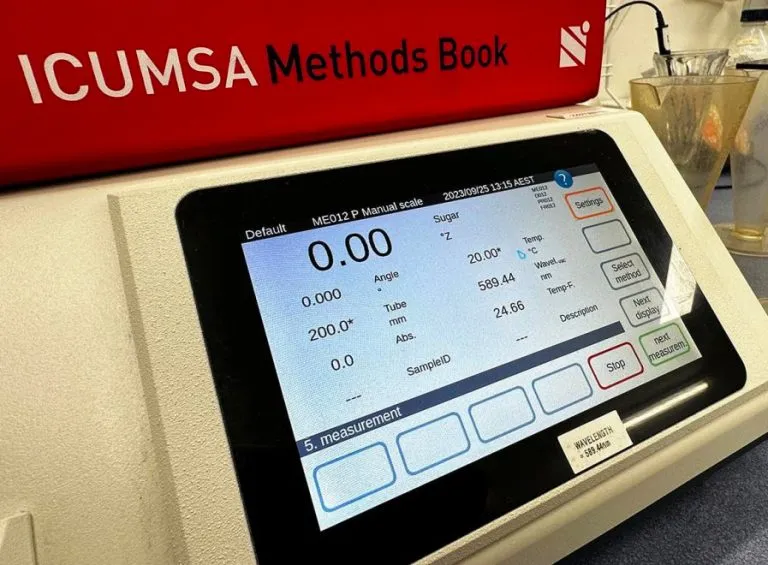
ICUMSA (International Commission for Uniform Methods of Sugar Analysis) color measurement is the global benchmark for sugar quality grading. Our laboratory performs ICUMSA testing on every production batch using spectrophotometric analysis at 420nm. Refined white sugar is verified to meet ICUMSA 45 standards (maximum 45 RBU), while other grades are tested against their specific ICUMSA targets to guarantee compliance with international trading specifications.
Moisture Analysis
Max 0.04% moisture on refined
Moisture content directly affects shelf life, flowability, and caking. Our QC team uses oven-drying and Karl Fischer titration to measure moisture at key points — post-crystallization, post-centrifugation, and final packaging. Refined white sugar ships at ≤0.04% moisture; raw sugar at ≤0.5% — both well within international trade specifications.
Crystal Size Control
Laser particle analysis
Uniform crystal size is what distinguishes premium refined sugar from commodity product. Our automated sieve analysis and laser particle sizing verify crystal distribution matches specifications — medium granulation for retail ICUMSA 45, coarse for industrial, and ultra-fine for confectionery-grade powdered sugar.
Contaminant Removal
Metal detector on every line
Every packaging line runs through calibrated metal detectors (detecting ferrous, non-ferrous, and stainless steel contamination down to 1mm). Combined with magnetic filtration on process streams and visual inspection stations, this ensures zero-contamination finished product ready for food manufacturing applications.
Laboratory Testing
24-hour in-house lab
Our in-house quality control laboratory operates 24 hours during the crushing season, performing over 500 tests daily — ICUMSA color, polarization (sucrose content), reducing sugars, ash, SO₂, heavy metals, microbiological counts, and pesticide residues. Every batch is certified before leaving the facility with a full Certificate of Analysis (COA).
Packaging Inspection
100% batch-tested
Pre-packaging: every bag is weight-verified on calibrated load cells (±50g tolerance on 50kg bags). Bag integrity, stitching quality, and correct labeling are 100% inspected. Retail and private-label packs additionally undergo printing quality and artwork verification before palletization.
Pre-Shipment Inspection
SGS / Bureau Veritas available
For buyers requiring independent verification, we coordinate third-party pre-shipment inspection by SGS, Bureau Veritas, Intertek, or CCIC. Inspectors sample at our facility, witness container loading and sealing, and issue a full inspection certificate matching the Certificate of Analysis — standard practice for Letter-of-Credit transactions and institutional buyers.
Quality You Can Trust
Request a Quality Sample
Receive a physical sample with full Certificate of Analysis. Our export team arranges dispatch within 3-5 business days.